Publisher
Category
Information
- Softcover
- 160 pages
- 180 x 230 mm
- ISBN 9781957011523
- English, Some Chinese
- 2026
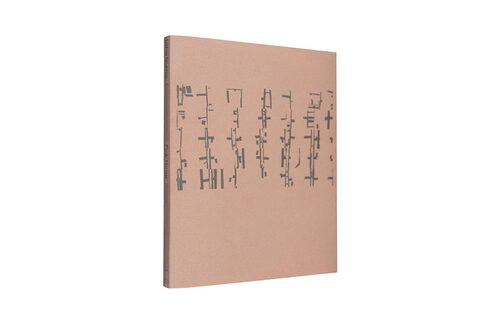
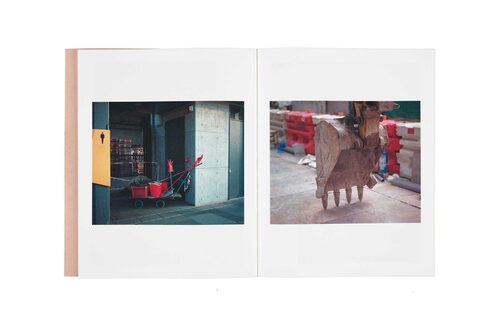
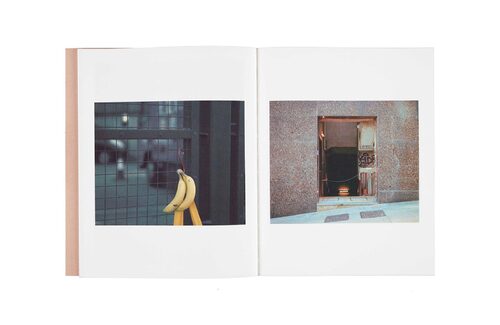
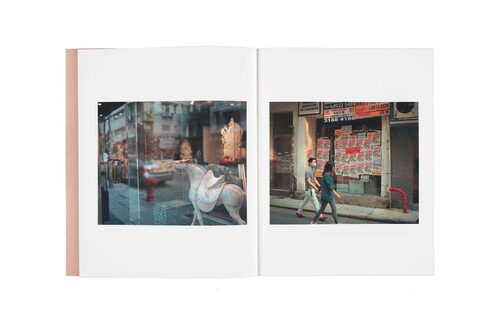
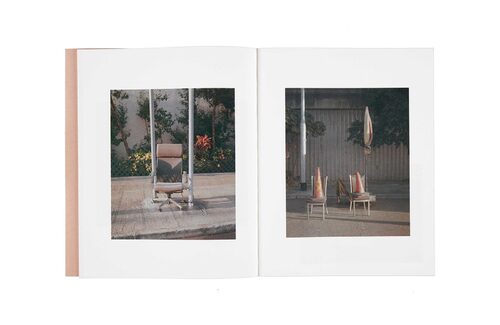
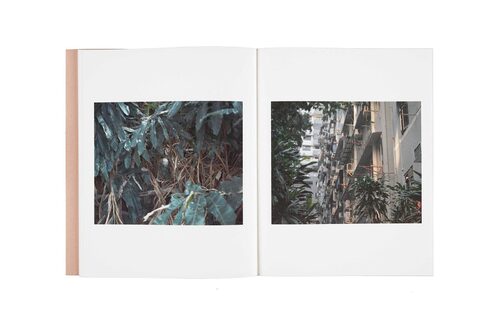
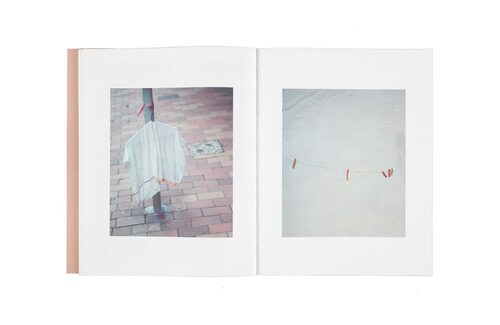
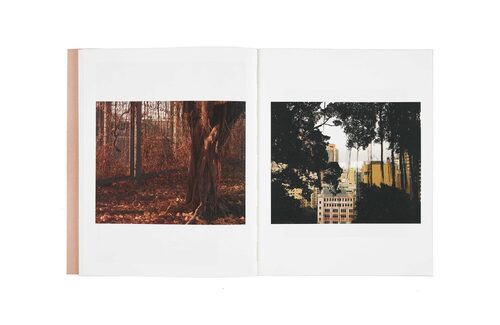
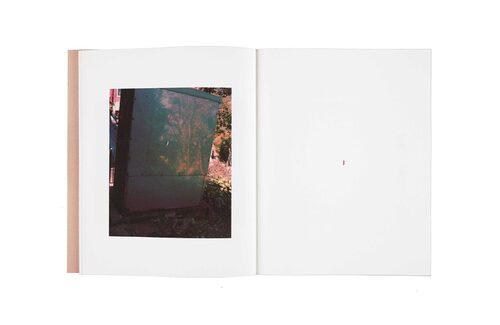
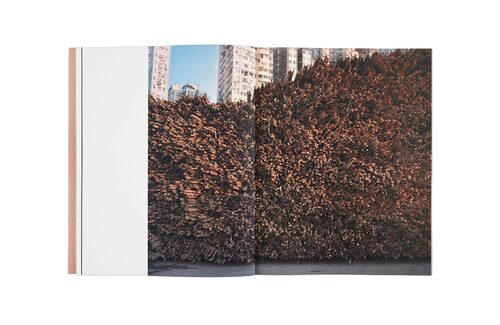
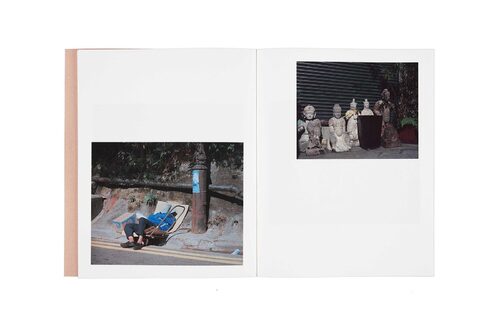
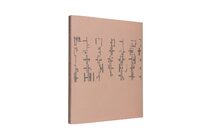
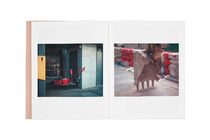
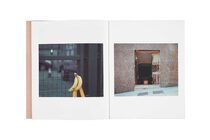
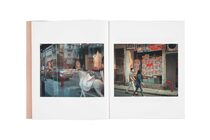
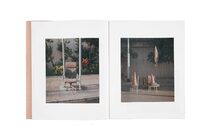
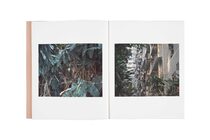
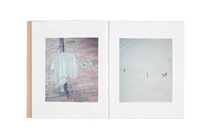
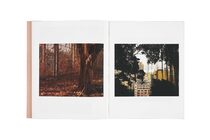
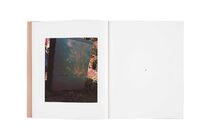
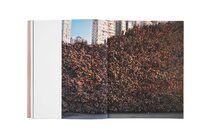
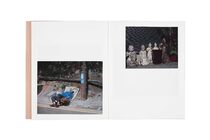
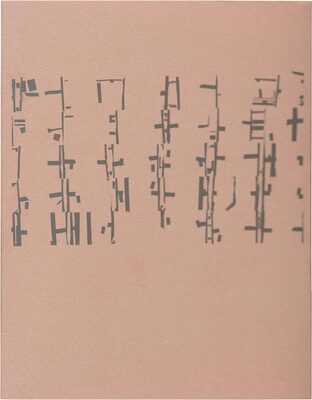
Centered on the metaphor of ‘pink noise’, the text and images of this book unfold as gently, inclusively, and steadily as pink noise itself, allowing human and non-human elements to settle and ferment, forming a sonic field. The layout of the images and text mimics a drum score composed by the author and is divided into seven short chapters. The stable, reassuring mood it evokes appears gentle on the surface but harbors a widespread presence that cannot be ignored.
Intro
With all of Pink Noise's images, its texts, right down to the choice of paper, finally settled, the project had, as far as I was concerned, graduated. And just then I made a trip to the Northwest. This was Dunhuang again, seven years on. This time we had chartered our own car, so I finally got out to Yumen Pass, and saw the Han dynasty Great Wall — "those heaps of dirt" — and a ruin called Dafangpan Cheng. At first glance they are not much different from the yardangs; look closer and the yardangs are coarser, these heaps finer-grained, and up close you can make out traces of something like reeds. The Han wall especially: ridge upon ridge. If this were the handwriting of wind, it would not be so finely divided. I imagine the archaeologists of the day found the marks of human labor in exactly such minutiae, and so confirmed that they were made. The mounds of Dafangpan Cheng are more primitive by comparison, because after all they were once walls — high, with holes punched through them as if by rocket fire, standing there proudly in the light two hours before sunset, dissolving into a pale blue sky that owns two or three clouds, like a rock stratum issued specially to the Northwest, standing for hundreds of millions of years, carved for hundreds of millions of years. Luckily humanity hasn't gone extinct yet: they noticed that this particular set of dirt heaps was not ordinary, looked into it, found it to be the family estate of the ancestors, and decided it had better be fenced off properly so that more of their own kind could come and pay their respects. The collective narcissism of the species keeps the noise from being truly "pink" — but it made me more certain than ever that I was looking at pink noise realized. It happened to be early summer. Wait until midnight and look at the zenith: Altair, Vega and Alpha Cygni make the Summer Triangle. Alpha Cygni's old Chinese name is Tianjinsi, Fourth Star of the Celestial Ford, and it lies more than two thousand light years away. Meet its gaze, and the light it casts into your eye set out at the moment this town, this line of walls, was built. At that moment, the background music of the universe is heard.
Every image in Pink Noise comes from Hong Kong. Hong Kong, the summation of contemporary industrial civilization: towers packed shoulder to shoulder into the hills, the living space of ordinary people compressed to its limit, a daily rhythm tuned to capitalism's maximum efficiency. This ultra-high density, physical and spiritual at once, makes me doubt from time to time the justice and the necessity of human existence. From ignoring it to being curious, from criticizing it to making peace with it — all of it condensed at last into the set of analogies that is Pink Noise. If in Hong Kong pink noise was a conception, then in Dunhuang what I saw was the background music already playing. Hold on. That phrasing sounds familiar.
I went hard at my old files, and sure enough — seven years ago, the first time I went to Dunhuang, I had written a short piece that ended like this: "The three days in Dunhuang went by very fast, like living through a flash mob, and back in Hong Kong we all felt a strong spiritual maladjustment. By most definitions Dunhuang and Hong Kong look like a pair of antonyms. Dry against humid, cool against sweltering, open against cramped, level plains against concrete jungle. But along the axis of history they seem very alike: when land routes ruled, Dunhuang happened to sit at the midpoint of trade between China and the West, and so became a hub of cultural exchange between them; when sea routes ruled, Hong Kong — loosely speaking the finest deepwater port in the Far East — took up the same role without hesitation for the trade and culture of today. Dunhuang once thronged with carts and horses, Hong Kong now a world of flowers and lights: the way the two cities came into being and grew turns out to follow one and the same line. Unexpected — and then, thinking about the logic behind it, entirely reasonable. A thousand years from now, will Central be fenced off for viewing the way the Xuanquan Post Station is, with tourists across the Shenzhen River gazing up at the platform on Victoria Peak and sighing, ‘Cuan Sanmiao yu Sanwei’[1]?”
So the line of thinking behind Pink Noise had drawn a much larger closed loop. I hadn't realized it myself: seven years ago, fate walked me to a node ofthought. I remember that after coming back from Dunhuang I kept wanting to pursue something metaphysical, and right around then I met Tim, and the formal exploration of art began, naturally enough. I thought Pink Noise was a four- or five-year project; in fact it had been fermenting for seven. I thought I had found a marvelous metaphor; it turns out fate had assigned me the topic long before.
So I am only a speaksperson who happened to be chosen — to grind and fabricate a principle of nature by human means, and then tell it to humans. But to be chosen is already enormous luck.
[1] Shang Shu (Book of Documents): Sanmiao is an ancient confederation of tribes in early Chinese history that resisted the central authority. The quote describes the legendary wise ruler Emperor Shun punishing unruly tribal groups Sanmiao to bring order and peace to the realm, by exiling them into Mount Sanwei, which is located in the western frontier, near present-day Dunhuang.
Outro
Pink Noise is a macroscopic metaphor, one that points toward more abstract ideas. When I first started working on it, I tried to downplay Hong Kong's presence — because the decline of industrialization and human adaptation ought to be universal themes, not confined to a single city or a single sentiment. But I soon noticed that everyone who flips through the work immediately recognizes it as Hong Kong, and inevitably asks: what do these atypical Hong Kong landscapes imply?
So I gave up on the idea of "de-Hong Kong-ing" the project. Pink Noise, I think, is indeed a project that grew out of Hong Kong. They say names are spells. From the moment it was christened with the brilliantly evocative term "concrete forest“ — and if we take that term seriously, then Hong Kong is always going to be the site of a Democratic Forest, an absolute, post-anthropocentric democracy where everything counts equally. To talk about human activity in an age when everyone is itching to move might seem to suggest a kind of passive-aggressiveness. But it's quite the opposite — it's an aggressive passiveness: one extreme industrialization collapsing into the next, so dense that a needle couldn't even lie flat within it. Passivity is not a posture; it's the only space left to exist.
The place where I take drum lessons is an industrial building in Kwai Hing wrapped in bamboo scaffolding; on unlucky days you have to transfer into a paint-splattered freight lift whose iron gate you haul up by hand before it will run. I'd rather practice at the drum room in Futian a friend recommended than go to class at all — it sits on top of a wet market (you couldn't even call it a second floor), but there simply isn't that anxiety that comes purely out of a tight space. I've come to call it "Hong Kong Retro Anxiety”[1] — the kind of high-contrast, saturated longing that looks gorgeous and suffocates you at the same time. Like the neon of Yau Tsim Mong, or the ghosts in Lan Kwai Fong at Halloween, it's alluring and dangerous, and on its way past it snuffs out the impulse to ask questions. It occurred to me once that Hong Kong might be the only place that has lived industrialization as though it were an indigenous way of life. The loss that people mourn here is, in essence, an indigenous loss — inevitable, lingering, as drawn out as the days of the monsoon season. And that melancholy isn't because something particularly precious has been lost, but because it has finally begun to be carried along by time, like every ordinary civilization before it. It is not special — and that very lack of specialness, for those who once were, is itself a loss of agency.
And Pink Noise is something like a bedtime signal broadcast to everybody, telling them there’s nothing to worry about: bamboo goes up over a building and comes back down, a building weathers and a tree withers — "it's all the same.”[2]
[1] Hong Kong retro style is a nostalgic design and fashion movement that reinterprets the city's "golden era" from the 1950s to the 1990s, blending iconic local elements like neon signs, bamboo scaffolding, and cheongsams with contemporary aesthetics. Yet beneath its alluring surface, this style embodies an underlying emotional tension—an anxiety and sense of impermanence rooted in the city's history, reflecting a collective fear of loss[1] Hong Kong retro style is a nostalgic design and fashion movement that reinterprets the city's "golden era" from the 1950s to the 1990s, blending iconic local elements like neon signs, bamboo scaffolding, and cheongsams with contemporary aesthetics. Yet beneath its alluring surface, this style embodies an underlying emotional tension—an anxiety and sense of impermanence rooted in the city's history, reflecting a collective fear of loss and a desire to preserve cultural identity amid relentless change.
[2] "It's all the same"—the last words of Zhang Beihai in Liu Cixin's The Dark Forest (the second book of the Three-Body trilogy). As the natural selection ship is about to be destroyed, he accepts the outcome with quiet equanimity, recognizing that whether he or another survives, the continuity of the human species is what matters.
About the Artist
Lisha (Lisa) Sheng(盛麗莎)
Working with both film and digital photography, Lisa employs a restrained and meticulous observational approach to explore the subtle yet powerful tension between the individual and the rapidly evolving city, capturing the moments of introspection that emerge from this dynamic.Her background in investment banking serves as an anchor for her practice, enabling her to reflect on the psychological and societal impacts of modernization and urbanization.
Publisher
Category
Information
- Softcover
- 160 pages
- 180 x 230 mm
- ISBN 9781957011523
- English, Some Chinese
- 2026